.png)
everything RF recently interviewed Dr. Edgar Felipe Garay, the founder and CEO of Falcomm. He received dual B.S. degrees in Physics (2009) and Electrical Engineering (2010) from Florida International University, followed by an M.S. in Electrical Engineering from the University of Florida in 2013. He earned his Ph.D. from the Georgia Institute of Technology in 2023. During his time at Georgia Tech, he invented a novel class of ultra-efficient solid-state power amplifiers known as Dual-Drive PAs, which became the foundation for Falcomm’s patented Dual-Drive™ architecture.
Q. Can you start by giving us a brief overview of Falcomm—when the company was founded, the problem you set out to solve, and the mission that drives your focus on high-efficiency RF power solutions?
Dr. Edgar Felipe Garay: Falcomm is a fabless semiconductor company founded in 2021 and headquartered in Atlanta, Georgia. We started Falcomm to solve a fundamental bottleneck in modern wireless systems: RF power amplifiers waste too much energy as heat, which limits range, battery life, payload capability, and reliability, especially at high power and high frequency.
Our mission is simple: make wireless transmission dramatically more energy-efficient by delivering high-efficiency RF and mmWave power amplifier solutions that cut power draw and improve thermal performance while improving real-world systems.
A key accelerator of that mission is our AI effort, GaNdalph.ai, an AI-driven RF chip design platform built around foundry-specific foundation models. Instead of generic “one-size-fits-all” AI, we train models that are tied to a particular manufacturing process and PDK, learning the nuances of that node: transistor nonlinearity and bias/temperature behaviour, passives and EM parasitics, layout-dependent effects, and packaging interactions. The result is a design engine that can rapidly predict and optimize performance within the exact constraints of a given foundry technology, enabling faster iteration and higher confidence silicon.
In short: Falcomm reduces RF energy waste at the source, and our foundry-specific foundation models make it possible to deliver breakthrough efficiency faster, repeatably, and at scale across multiple nodes and processes.
Q. Falcomm is best known for its Dual-Drive™ Power Amplifier technology. Can you explain this architecture in simple terms, and how it differs from conventional RF power amplifier designs?
Dr. Edgar Felipe Garay: Dual-Drive™ is a fundamentally new power-amplifier architecture that increases RF output power and efficiency by driving the gate and source simultaneously. Traditional power amplifiers are typically common-source designs, which means they are limited by the knee-voltage headroom of the device. When the RF drain voltage swings below the knee voltage, the device begins to turn off, which limits output power and efficiency at the device level. Dual-Drive™ power amplifiers overcome this limitation by applying the RF signal at the source of the device. By doing so, the device can remain on for the full RF cycle, increasing RF output power and efficiency at the same DC quiescent point.
Q. What are the key advantages of Dual-Drive™ in terms of efficiency, linearity, and output power, especially when compared to traditional GaN, LDMOS, or CMOS PA approaches?
Dr. Edgar Felipe Garay: Falcomm’s Dual-Drive™ architecture is process- and frequency-agnostic, and its key advantage is that it breaks the traditional trade-off between efficiency, linearity, and output power. Conventional GaN, LDMOS, and CMOS power amplifiers typically force system designers to optimize one at the expense of the others. Compared to conventional approaches, Dual-Drive™ delivers higher efficiency at comparable or higher output power, which directly reduces heat, lowers system power consumption, and improves reliability. At the system level, this translates into smaller thermal footprints, reduced cooling requirements, and increased mission endurance.
Q. One of Falcomm’s strengths is that the same architecture scales across CMOS, SOI, GaN, and GaAs platforms. What enables this portability, and why is it important for customers looking to optimize SWaP-C and system performance?
Dr. Edgar Felipe Garay: Dual-Drive™ is an architectural innovation rather than a process-specific trick. The performance gains come from how the device is driven, not from reliance on a particular semiconductor material. This allows the same core design principles to be implemented across CMOS, RFSOI, GaN-on-Si, GaN-on-SiC, and GaAs. This portability is critical for customers optimizing SWaP-C, as it gives system designers flexibility to select the best process technology for their application—whether that’s cost and integration, ruggedness, or maximum power—while still benefiting from Falcomm’s efficiency and performance advantages. The result is better system-level optimization without architectural lock-in.
Q. Can you walk us through Falcomm’s current RF product portfolio? We see both CMOS- based and GaN-based PA solutions—how do customers typically choose between these platforms?
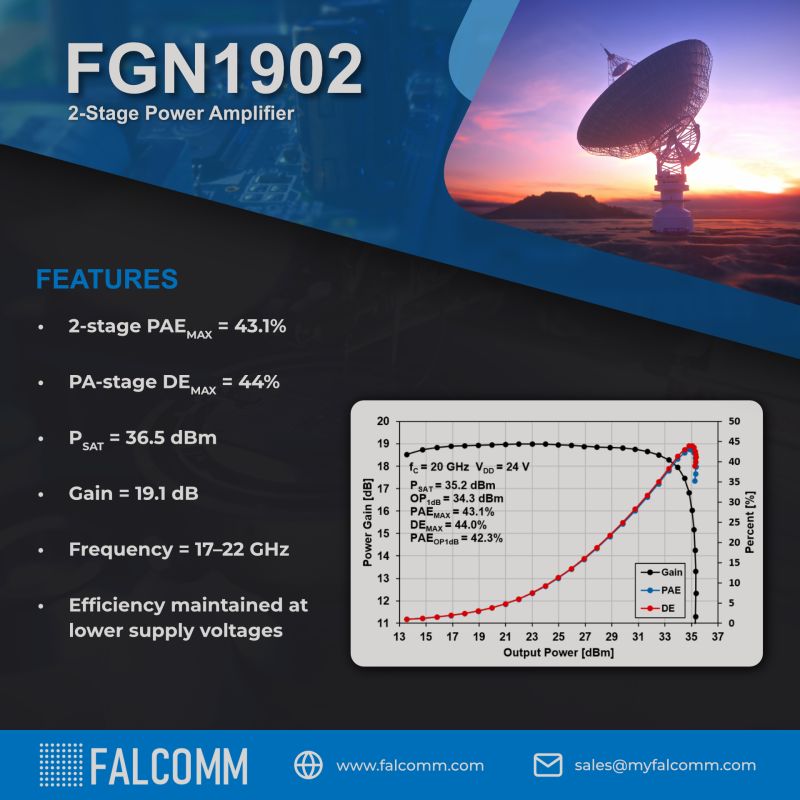
Dr. Edgar Felipe Garay: Falcomm’s portfolio includes CMOS/RFSOI and GaN power amplifiers, with products spanning X-band through Ka-band. Customers typically choose CMOS or RFSOI when they prioritize high integration, small form factor, and cost-effective scaling. GaN-based solutions—on silicon or silicon carbide—are selected when applications require higher output power, wide bandwidth, and stronger thermal performance, particularly for SATCOM and defense. The key is that customers can select the best platform for their system while still achieving Falcomm’s efficiency and linearity advantages.
Q. Beyond discrete power amplifiers, is Falcomm also developing more integrated solutions? If so, how do front-end modules (FEMs), beamforming ICs, and mmWave building blocks fit into your broader product strategy?
Dr. Edgar Felipe Garay: Yes, discrete power amplifiers are just one layer of the RF stack. Falcomm is developing front-end modules, beamforming ICs, and mmWave RF building blocks that integrate power amplification with additional RF functionality. As systems move toward phased arrays, wider bandwidths, and higher frequencies, customers increasingly want turn- key, highly integrated RF solutions that reduce complexity and shorten development cycles. Our strategy is to extend our technology across the RF front end, enabling complete, scalable solutions for next-generation wireless, satellite, and defense systems.
Q. Which market segments are you currently most focused on?
Dr. Edgar Felipe Garay: We are focused on markets where RF efficiency is mission-critical and system- limiting, including commercial space and satellite communications, defense and national security, and wireless infrastructure. In satellite and defense applications, efficiency directly impacts payload mass, thermal management, and mission endurance. In wireless infrastructure and emerging mobile markets, it enables extended range, reduced energy consumption, and lower operating costs. Across all these segments, demand for efficient, broadband RF power continues to grow rapidly.
Q. Falcomm positions itself as a provider of full turn-key RF solutions — from RFICs to custom designs. How does this model help customers shorten development cycles and de-risk complex RF programs?
Dr. Edgar Felipe Garay: We deliver turn-key RF solutions ranging from RFICs and packaged power amplifiers to custom designs and evaluation boards, so customers aren’t starting from scratch. Because our solutions are validated and characterized, teams can avoid late-stage redesigns and move from prototype to production faster. This is further enabled by our AI-powered RF design platform, GaNdalph.ai, which accelerates iteration and optimization and helps bring products to customers and to market more quickly.
Q. Finally, what can the industry expect from Falcomm in the near future — whether in terms of new product families, expanded frequency coverage, or strategic partnerships?
Dr. Edgar Felipe Garay: In the near future, the industry can expect Falcomm to continue expanding new RF product families to encompass broader frequency coverage, diverse power levels, and wider bandwidths. At the same time, we are strengthening strategic partnerships across manufacturing, defense, and commercial space, and advancing our AI-powered design automation platform, GaNdalph.ai, to further accelerate RF power amplifier design and innovation. All of this supports our long-term vision of establishing Falcomm as a globally competitive, U.S.-based leader in high-efficiency RF microelectronics.